
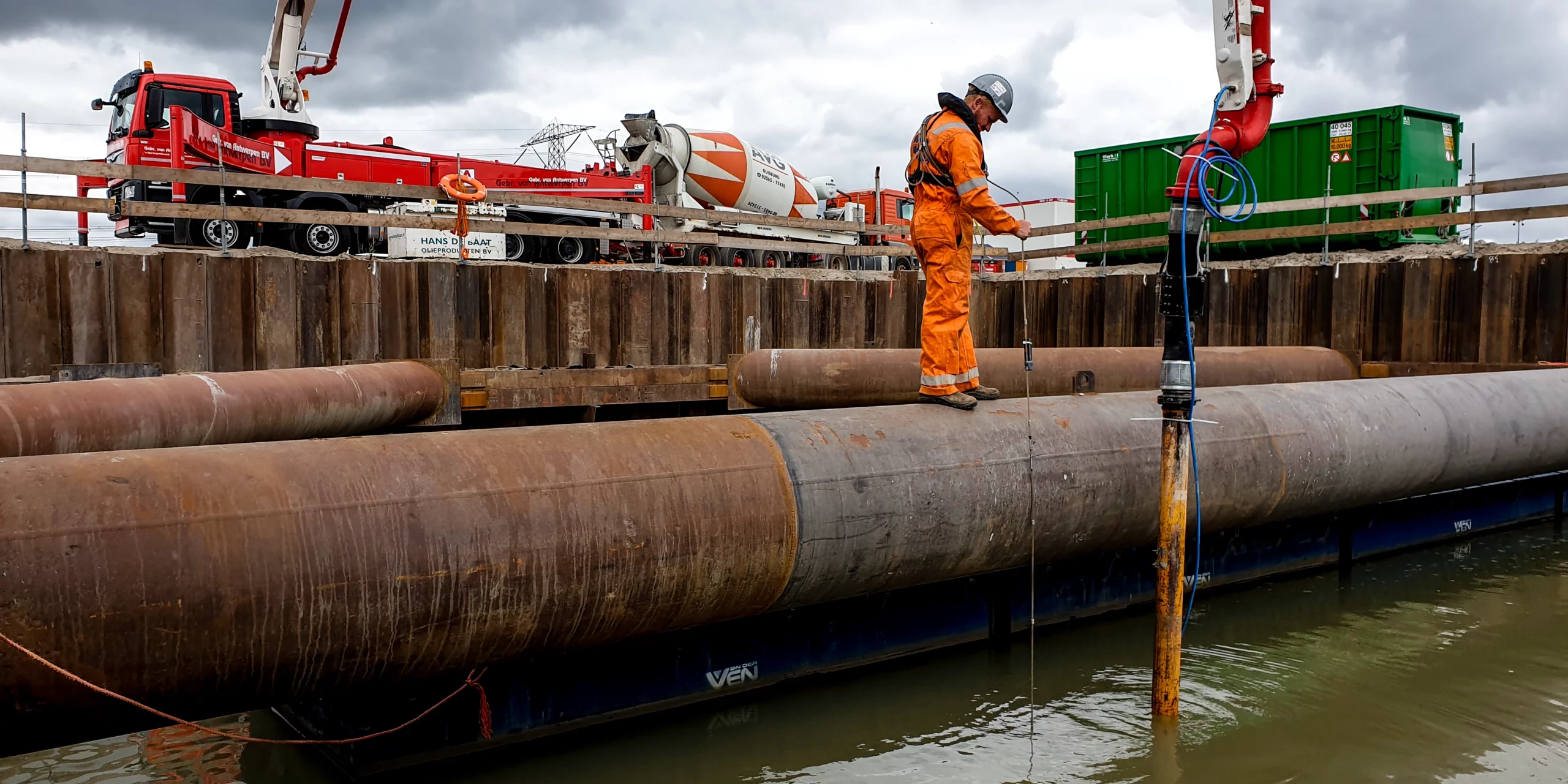
In this step-by-step guide, you will learn exactly how underwater concrete pouring works and how it results in a reliable underwater structure.
What is underwater concrete?
Underwater concrete is concrete that is poured while it is in direct contact with water. There are two types.
The first type is colloidal concrete: standard structural concrete with an additive that prevents the mix from segregating or washing out, even in flowing water. This concrete is often used to fill gaps between armour stones.
The second type is high-slump concrete: a highly workable mix specifically designed for pouring concrete underwater using a concrete pump. This mixture would normally segregate as soon as it comes into contact with water. For this reason, the discharge pipe remains continuously embedded in the previously poured concrete throughout the entire process. This creates a strong, dense and level concrete slab for construction pits, foundations, and other civil engineering structures.
Why pour concrete underwater?
When pouring underwater concrete, the second type of concrete is almost always used, the high-slump type poured using a concrete pump. Underwater concrete is essential for projects where a construction pit cannot be kept dry due to high groundwater pressure or site constraints.
Once cured, the slab forms a stable and watertight seal at the base of the construction pit. This underwater slab then serves as the base for basement structures, foundations and other civil engineering structures. In many projects, this is a vital component within the overall foundation.
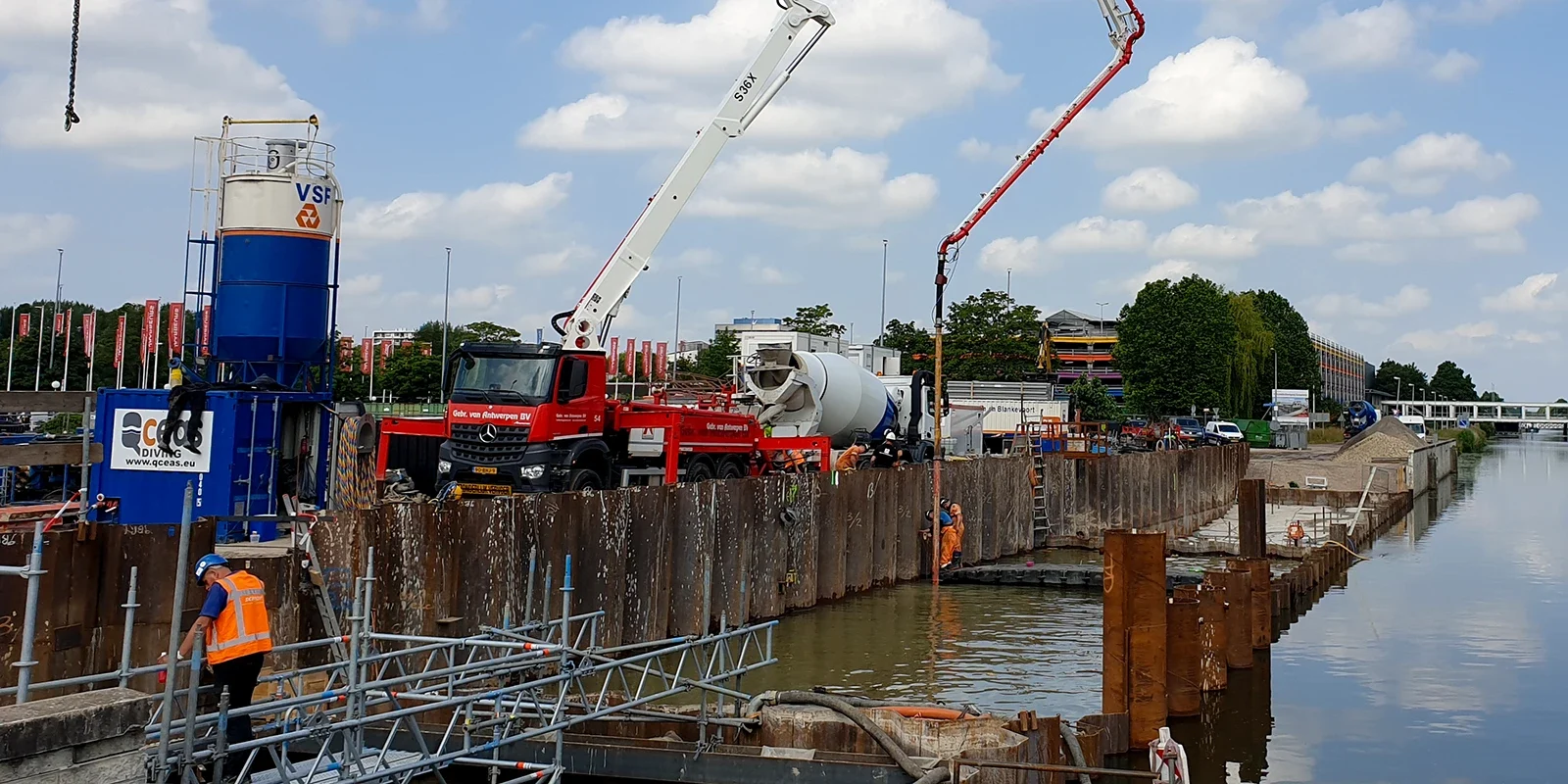
The pouring process: how underwater concrete is applied
Pouring underwater concrete may seem simple at the surface, but underwater, every step counts. You can read about how the process works in practice below.
1. Preparing the construction pit
Before the concrete can be poured, divers inspect the entire construction pit / cofferdam. They assess the condition of the walls, the joints, the anchors and check how level the base is.
Underwater, they pay particular attention to foreign objects on the base, such as construction debris, peat residues or rubble. If it is possible for any of these to interfere with the pouring process, they are removed to ensure that the bed is clean and stable.
If the base is not correct, this can have adverse consequences on the strength, levelness and watertightness of the slab, both during and after the pouring process.
2. Placement of the gravel layer
A layer of gravel can be placed on the bed to improve the subgrade. The gravel provides additional ballast and forms a stable buffer between the concrete and the bed.
The voids in the gravel absorb residual silt, which originates from both the native bed and the cement laitance generated during the pour. Divers carefully check that the gravel layer has the correct height throughout before the pour can begin.
3. Positioning the concrete pump
Prior to the pour, a pre-pour meeting is held to determine how the concrete will be placed: via a floating tremie system or directly from the concrete pump. Consideration is also given to the pump’s setup location, the access route for the concrete mixers and water level control during the pour.
The water level rises as the pour progresses. This means that an assessment is made as to whether this needs to be pumped out in a controlled manner. If necessary, pontoons are brought in to ensure sufficient mobility on the water.
The pour can only begin once all preparations are complete.
4. Start of the pour
The pour begins by thoroughly purging the concrete pump’s pipework to remove all air. Once it is completely free of air and filled with concrete, the tremie pipe is brought into the pre-determined location.
The diver verifies that the tremie pipe is suspended at the correct height and that it remains fully embedded in the previously poured concrete. Once this has been confirmed, the actual pumping can begin.
5. Distribution of the concrete
The underwater concrete has a high slump and spreads across the bed as it flows out. At a certain point, the concrete pump can no longer push the concrete forward, and the mixture rises up at the tremie pipe. This moment is closely monitored.
As soon as the concrete layer reaches the predetermined height, the tremie pipe must be moved according to a predetermined pattern. This phase requires constant communication between the pump operator and the levelling team.
A uniform, uninterrupted pour is essential for achieving a strong and level concrete slab.
6. Curing the underwater slab
Curing concrete is a thermal process and generally proceeds more slowly in cold water. The development of the concrete’s strength is tracked using calibration charts and maturity meters that continuously monitor the concrete temperature.
Only once the predetermined strength has been achieved can the construction pit be pumped dry and work above water be continued.
The role of divers
Divers are essential during every stage of the pouring process. They check heights, clean walls, guide the tremie pipe and constantly monitor the safety and quality of the work area.
Without specialised diving operations, achieving a reliable underwater slab is not possible. Consequently, neither is a sustainable underwater structure.
A reliable solution for groundwater
Underwater concrete placement is a process in which preparation, coordination and craftsmanship are key. When every step is carried out with precision, the result is a strong, watertight slab that provides a solid foundation for safe civil engineering structures.
For locations with high groundwater pressure or limited construction space, underwater concrete placement is often the most reliable and efficient solution.
Curious about how we can pour underwater concrete for your project?
Contact us for more information.

Qceas
Rijbosch 13
4112 MB Beusichem (NL)


